
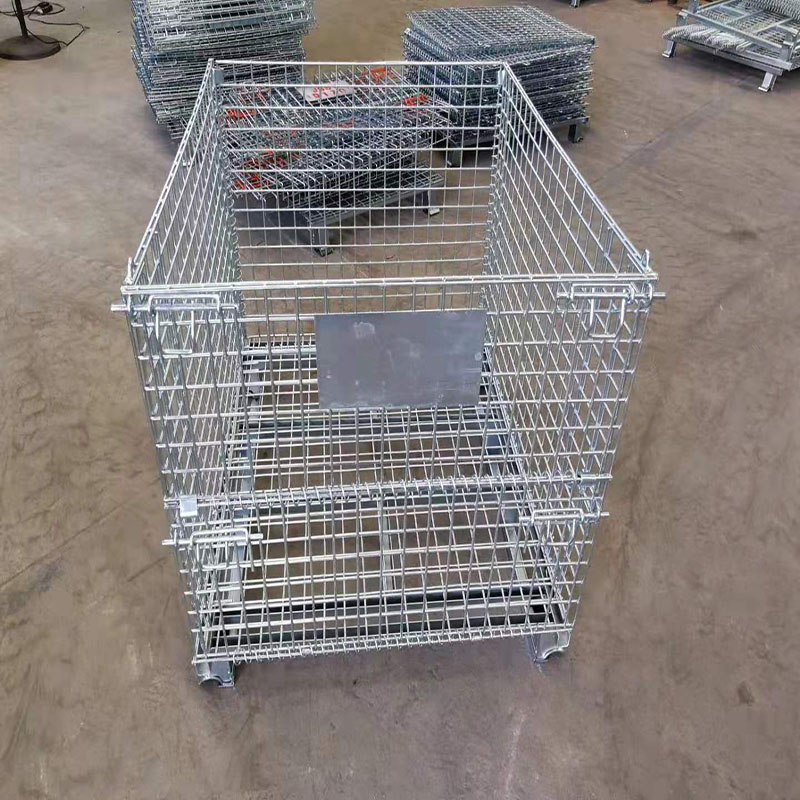
Many people meeting a warehouse cage for the first time get lost in its many names. They all refer to the same product. Here is a clear look from several angles. 1. Material and manufacturing process Xintongnuo warehouse cages are mainly welded and assembled from Q235 water-drawn steel wire plus channel steel. The flow is roughly: wire drawing, cutting, electric welding and edge trimming to make mesh panels; then stamping foot cups, bending the bottom U-channel, making the mesh-connecting springs, machining the base; electroplating each part, and final assembly. 2. Alternative names of the warehouse cage The cage grew out of visual management and has many names: warehouse cage, butterfly cage, storage cage, transfer box, foldable warehouse cage, foldable wire basket, material box, foldable mesh basket, flying cage - they all mean the same thing. 3. Common sizes Common sizes include 800*600*640, 1000*800*840, and 1200*1000*890. Mesh openings include 50*50, 50*100, 100*100, 25*25, and 50*25. Xintongnuo can also build to customer requirements or from drawings and samples. 4. Range of use It folds and stacks, and works with hollow boards, racking, forklifts, and pallet trucks. It covers a wide range of industries: auto parts, machinery, warehousing, logistics, electronics, power, apparel, hardware, motors, and machining. 5. Why buy a warehouse cage It is a standardized logistics container for storing and turning over raw materials, semi-finished goods, and finished products. It is simple to operate, versatile, and long-lived. Uniform specs mean clear storage and easy stocktaking. Full cages stack four layers high; empty cages fold flat to save space. Pair it with a forklift, hydraulic pallet truck, casters, or towing attachment, and it covers transport, handling, loading, and storage.