
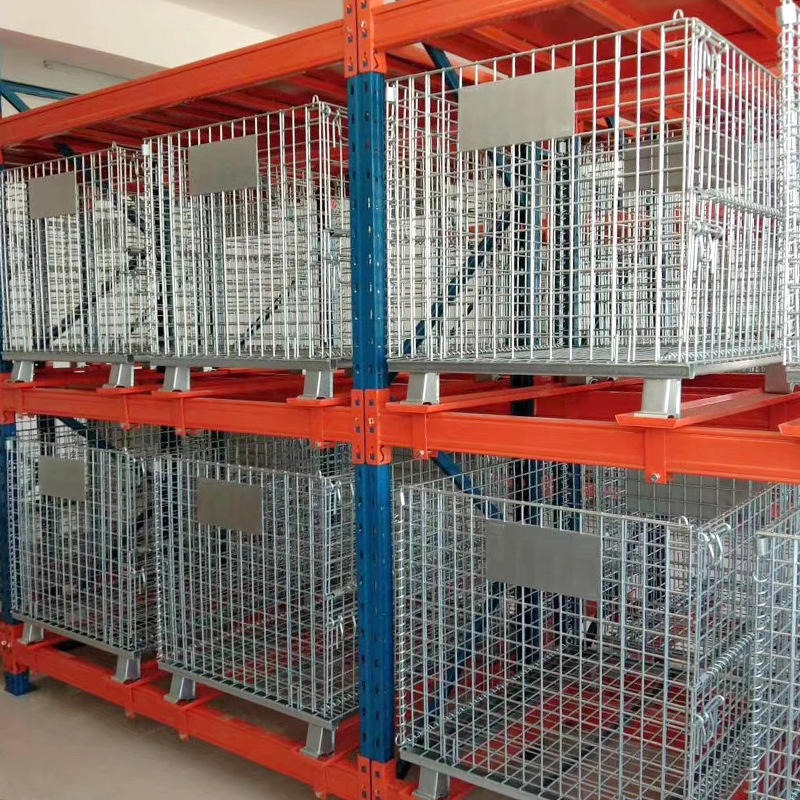
A rack-mounted warehouse cage is a returnable container for goods in transit, often used for loose or bulk items. Also called a butterfly cage, it is adopted by more and more large companies for warehouse management, and can sit on beam racks in daily operation. Placing a cage directly on a beam rack can make the rack system unstable, so a support should be designed on the beam rack, and a forklift used to put goods in and take them out. Two points matter when designing a rack-mounted warehouse cage. 1. Cage style A common non-standard version is the wheeled cage: casters on the bottom let it roll freely across the workshop floor. Wheeled cages do not belong on racking — the wheels would roll, the cage would not stay fixed, and a safety risk appears. Rack-mounted cages are therefore built without wheels, so they cannot drift or fall. 2. Bottom support design A rack-mounted storage cage needs fixed supports, built from combinations like angle steel and square tube. Angle steel is chosen for its strong load capacity, and square tube fixes the cage in place so the rack stays safe and the forklift can set the cage down and lift it out steadily. Many small or irregularly shaped but heavy goods, which lack large packaging, are first loaded into a storage cage and then placed on the rack — this is a common solution for small or irregular items.